

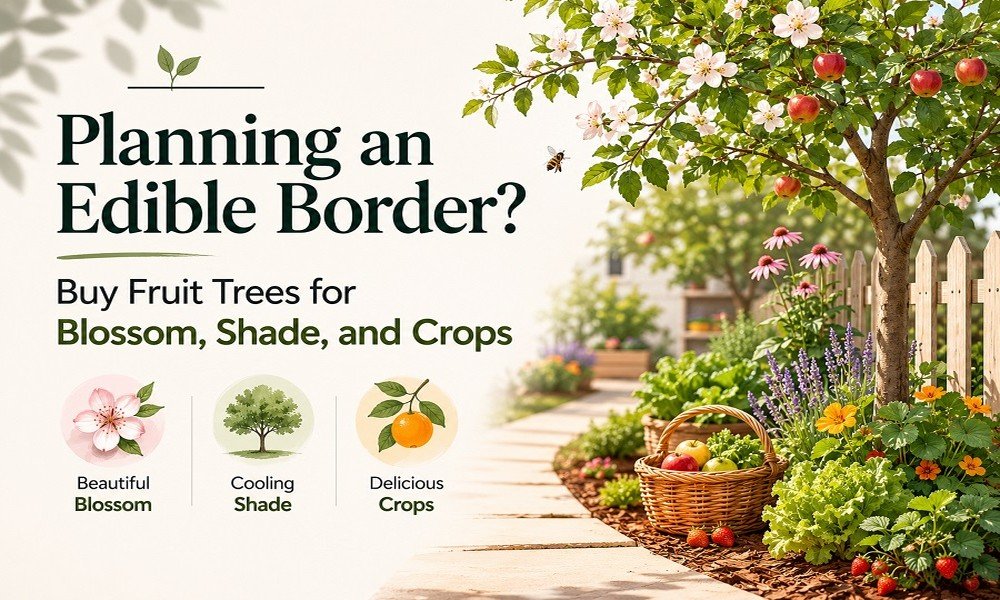
An edible border does not have to look like a vegetable plot. In many British gardens, the most successful productive planting sits among ornamentals, herbs, bulbs, shrubs, and perennials. A fruit tree can be the anchor of that border, giving height, spring blossom, summer shade, autumn crops, and winter structure.
The challenge is to plan the tree as part of the design rather than adding it after the border is full. Roots, light, access, and mature spread all affect what can grow around it. A fruit tree can improve an edible border, but only if it has enough space and the surrounding planting supports rather than competes with it.
For gardeners who buy fruit trees with an edible border in mind, the fruit tree specialists at Fruit-Trees suggest placing the tree first and designing the lower planting around it. That approach protects access for pruning and picking while allowing herbs, flowers, and seasonal crops to complement the tree rather than crowd it.
This article explores how fruit trees can work in mixed borders for British gardens. It considers form, companion planting, maintenance, and the balance between productive ambition and a border that still looks composed.
An edible border works best when productivity and appearance are planned together. The fruit tree should not look like a compromise inside an ornamental scheme, nor should the border become so productive that it loses grace. The aim is a garden feature that feels attractive, seasonal, and useful without asking the tree to compete with crowded planting.
The article also assumes that edible planting should still feel restful. Productive gardens can become cluttered when every gap is treated as an opportunity. A fruit tree gives the border a long-term anchor, allowing the surrounding planting to be edited, repeated, and refreshed without losing the main structure.
That restraint is particularly useful in British gardens where borders often have to look good from the house throughout the year. The fruit tree provides continuity while bulbs, herbs, perennials, and seasonal crops change around it.
Let the Tree Set the Structure
A border with a fruit tree needs a clear hierarchy. The tree is the long-term structure, while perennials, bulbs, herbs, and annual crops can change around it. If the lower planting is designed first, the tree may end up squeezed into a gap. Starting with the tree prevents the permanent element from being treated as an afterthought.
The form of the tree should suit the border’s purpose. A small bush tree can create a natural focal point. A cordon can add rhythm along a boundary. A fan or espalier can make a wall productive while keeping the bed below usable. The right form depends on space, light, and how formal or relaxed the garden should feel.
Height matters visually as well as practically. A fruit tree can lift the eye above herbaceous planting and make a border feel more layered. In a flat garden, that added height can be transformative. It gives the border a sense of maturity even before the tree is carrying heavy crops.
The tree’s structure should also guide the rhythm of nearby planting. Low, frothy perennials can soften the base of an upright tree, while taller plants may compete visually and physically. In a formal border, repeated herbs or clipped edging can make the fruit tree look deliberate. In a looser cottage-style border, bulbs and pollinator plants can create a more relaxed setting. The tree does not have to dictate a single style, but it should set the scale. Planting that ignores its presence will soon look crowded.
This structural planning also helps prevent the border from becoming too busy. When the tree’s outline is respected, the surrounding planting can be generous without obscuring the main feature.
Use Blossom as Part of the Planting Calendar
Fruit blossom is brief, but it can be one of the most memorable moments in an edible border. The tree flowers above emerging perennials and spring bulbs, linking ornamental display with future harvest. Apples, pears, cherries, plums, and quince all bring different blossom character, so the choice affects the mood of the border as well as the crop.
Planting around the tree can extend that seasonal interest. Early bulbs, primroses, wallflowers, herbs, and later perennials can create a sequence that supports pollinators and keeps the border lively. The aim is not to make the tree compete with everything around it, but to let the border carry the season forward after blossom fades.
Pollinator-friendly planting is especially useful near fruit trees. Flowers that provide nectar across spring and early summer can encourage beneficial insects into the area. Good pollination depends on weather and compatible varieties, but a border rich in insect life gives the tree a better setting than bare soil or dense, unhelpful planting.
Blossom timing can be coordinated with other spring plants so the border feels abundant rather than patchy. Early bulbs can open before the tree, followed by blossom and then herbaceous growth. This sequence keeps interest moving through the border and helps avoid the empty look that can follow a short display. The tree’s blossom should be allowed to stand out, not be buried behind competing shrubs. A little space around the framework gives the display more impact and helps pollinators move easily among flowers.
A thoughtful planting calendar gives pollinators reasons to visit before and after the fruit tree flowers. That continuity supports the wider garden as well as the crop.
Keep the Root Zone Calm and Open
An edible border can easily become too busy around a young tree. Vigorous perennials, groundcover, and annual vegetables may look productive, but they can compete for water and nutrients. A newly planted tree needs a calm root zone while it establishes. Mulch is often more useful than crowding the base with plants immediately.
Once the tree is settled, lower planting can be introduced carefully. Shallow-rooted herbs, bulbs, and modest perennials are usually easier to manage than dense shrubs or rampant groundcover. The trunk area should remain visible, and mulch should not be piled against the bark. Air and access are part of tree health.
Watering should be directed at the tree when needed, not only at the border surface. In dry spells, surrounding plants may mask how dry the soil has become around the root zone. A tree in a mixed border can suffer quietly because the rest of the bed still looks acceptable. Regular checking avoids that problem.
A calm root zone is especially important in the first two or three seasons. Gardeners often want instant fullness, but young trees establish better when competition is limited. Temporary annuals can be used lightly if they do not crowd the base, but deep-rooted or vigorous plants should wait. Mulch may look plain for a while, yet it is doing valuable work. Once the tree is stronger, underplanting can become richer. This staged approach gives both productivity and beauty without asking the young tree to fight for resources.
Mulch can be made visually acceptable with neat edges and repeated materials. It does not have to look unfinished, and it protects the young tree during its most vulnerable years.
Design for Picking, Pruning, and Pathways
A productive border must be usable. It is easy to plant beautifully and then discover there is nowhere to stand when pruning, thinning, or picking. Access can be built into the design with stepping stones, a narrow maintenance strip, or open ground on the side where most work will happen. This keeps care simple without making the border look utilitarian.
Branches should not be allowed to sprawl across paths or seating areas unless that is part of a managed design. Fruit trees can be pruned and trained, but the framework should be planned early. A branch that looks harmless in year two may become a regular obstruction by year five.
Picking also affects placement. Soft fruit that drops onto paving can be messy, while apples and pears may need space for a basket or ladder depending on tree size. In a family garden, it is worth considering how children or older gardeners will reach the fruit. A tree that can be harvested comfortably is more likely to be enjoyed.
Pathways do not need to be wide or formal to be useful. A few well-placed stepping stones can give access for pruning and harvesting while disappearing visually among planting. This is particularly helpful in deep borders, where reaching the tree from the front can damage surrounding plants. Maintenance access is easy to design at the beginning and difficult to add later. A productive border should invite care. If every task requires trampling flowers, the tree will receive less attention than it deserves.
Access should be checked in wet weather too. A route that feels fine in summer may become slippery or cramped in winter, just when pruning and inspection are needed.
Choose Crops That Suit the Border Style
Different fruits create different border moods. Apples feel familiar and adaptable. Pears can look elegant when trained. Plums offer generous blossom and useful crops, while cherries bring strong spring display. Quince adds a traditional character and bold autumn fruit. The choice should fit the garden’s style as well as the household’s appetite.
Kitchen use is still important. An edible border should produce food that is wanted, not just interesting. Cooking apples, dessert pears, plums for eating or preserving, and fruit for baking each lead to different variety choices. A beautiful tree that produces an unused crop will eventually feel less satisfying.
Seasonal timing can also be designed. A border with early blossom, summer herbs, late fruit, and autumn colour can feel balanced across the year. If space allows more than one tree, varieties can be chosen to spread interest and harvest. If space allows only one, that tree should earn its place in several seasons.
Crop choice can also reflect how the border is viewed. A tree near a seating area might be chosen for blossom and attractive fruit as much as yield. A boundary tree might prioritise trained structure and reliable cropping. A tree near the kitchen may be selected for fruit that is used often. These design decisions make the edible border feel personal. Instead of treating all fruit trees as interchangeable, the gardener chooses a role that fits the exact place the tree will occupy.
The border’s crop can be chosen to complement nearby herbs and flowers. A cooking apple, pear, plum, or quince may suggest different planting moods and kitchen uses.
Make the Border Productive Without Losing Grace
The best edible borders do not announce themselves as purely practical. They look settled, generous, and intentional. Fruit trees help because they combine beauty and use in one plant. Their presence allows the border to produce food while still feeling like part of the garden’s design rather than a separate growing area.
Restraint is important. Too many competing edible plants can make maintenance difficult and visual rhythm confused. A fruit tree, a few herbs, seasonal flowers, and carefully chosen underplanting may be more successful than a crowded catalogue of possibilities. Productive planting works best when each element has room to perform.
A fruit tree can therefore be the bridge between ornamental gardening and home production. It brings a long-term framework, supports wildlife, and offers harvest without requiring the garden to change character completely. Planned well, it makes the edible border feel natural rather than forced.
Grace also comes from leaving enough empty space. Productive gardeners often feel pressure to fill every gap, but fruit trees benefit from air and visibility. A clear outline lets the shape be appreciated in winter and makes summer pruning easier. The border can still be abundant; it simply should not smother the tree. This balance is what makes edible ornamental planting work. The garden feels rich, but the permanent fruiting structure remains legible and manageable.
Leaving space around the framework is a design choice, not wasted ground. It lets the tree breathe, keeps maintenance practical, and makes the fruiting structure easier to admire.
