
Clear visual guidance is one of the simplest ways to improve safety in a factory or warehouse. In a busy industrial space, workers need to know where to walk, where forklifts may pass, where materials should be placed, and which areas require extra attention. If these zones are not easy to recognize, people may enter the wrong area, block traffic lanes, or move too close to operating equipment.
This is why many modern facilities are using an Industrial Line Projector instead of relying only on painted floor lines or adhesive tape. Projected light lines are bright, easy to see, and not affected by daily floor wear. For factories with forklifts, dust, cleaning water, oil, or heavy foot traffic, this can make line marking more stable and easier to maintain.
A good Industrial Line Marking Projector does more than create a visible stripe. It helps turn color into a clear safety message. For areas that need stronger visual reminders, a Safety Warning Line Projector can help workers notice caution zones, restricted spaces, and traffic boundaries faster.
Some facilities also compare projected marking solutions with a Laser Line Projector because both can create clear guide lines on the floor. However, for factory safety marking, the right choice depends on visibility needs, installation conditions, working environment, and long-term maintenance requirements.
Green Lines for Safe Walking Routes
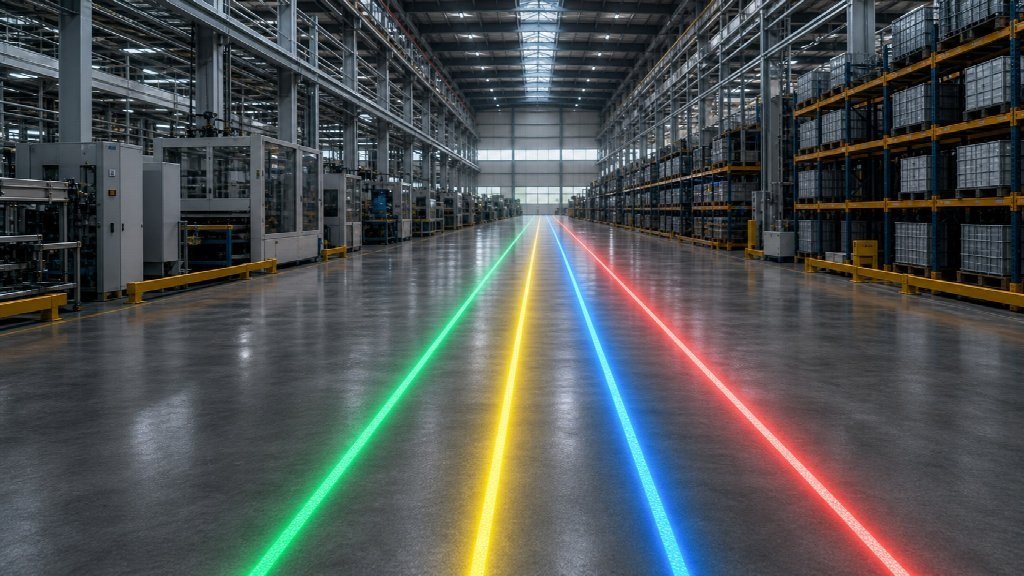
Green is commonly used to show safe movement. In factories, green projected lines are often used to mark pedestrian walkways, visitor paths, or safe walking lanes between work areas.
This is especially useful in warehouses and production plants where people and vehicles share the same floor. A green line gives workers a clear route to follow and reminds forklift drivers to keep pedestrian areas open. It can also help new employees and visitors understand the layout without needing long explanations.
When green lines are used consistently, the floor becomes easier to read. Workers know where they should walk, and managers can reduce the risk of people crossing into machine areas or vehicle lanes.
Yellow Lines for Caution and Shared Traffic Areas
Yellow is the color of caution. It tells people to slow down, look around, and stay alert.
Factories often use yellow projected lines near forklift crossings, loading docks, assembly stations, packing areas, and places where workers and vehicles may meet. These are not always restricted areas, but they do require more attention.

A yellow line can also be helpful around temporary maintenance zones. If a machine is being repaired or a work area is being adjusted, yellow projected marking can remind workers that conditions have changed.
For busy industrial sites, a Safety Warning Line Projector can make these caution areas easier to notice, especially in places where painted markings fade quickly or become covered by dust and tire marks.
Blue Lines for Material Placement and Work Zones
Blue is often used to mark functional areas. These can include raw material zones, finished goods areas, pallet staging spaces, tool placement areas, or inspection points.
Unlike red or yellow, blue usually does not mean danger. Its main purpose is organization. It helps workers understand where materials belong and helps managers keep aisles, exits, and production areas clear.
For example, a logistics warehouse may use blue lines to show where pallets should wait before shipping. A machinery workshop may use blue boundaries for spare parts or tools. A production plant may use blue marking to separate items waiting for quality inspection.
By using projected blue lines, companies can support cleaner floor management without repainting lines every time the layout changes.
Red Lines for Restricted or High-Risk Areas
Red is the strongest warning color. In industrial environments, it is usually used for restricted areas, high-risk equipment zones, or places where only trained workers should enter.

Red projected lines may be used around automated machinery, high-temperature equipment, hazardous material storage, vehicle-only lanes, or dangerous operation zones. The message is direct: do not cross unless you are authorized.
Because red has a strong warning meaning, it should not be overused. When it is kept for truly important safety boundaries, workers are more likely to notice it and respond correctly.
Why Projected Line Marking Is Better for Many Industrial Floors
Traditional floor paint and tape are common, but they can be hard to maintain in demanding environments. Forklift tires, foot traffic, moisture, cleaning chemicals, dust, and oil can damage physical markings. Once the lines fade or peel, the safety message becomes less clear.
Projected line marking avoids many of these problems. Since the line is created by light, it does not wear away from traffic. It can stay visible during daily operations and can be adjusted when the factory layout changes.
This makes an Industrial Line Marking Projector a practical choice for warehouses, manufacturing plants, logistics centers, machinery workshops, food processing factories, and other industrial spaces that need flexible safety guidance.
Noparde Projection Solutions for Industrial Safety Marking
Noparde provides industrial projection solutions for factories, warehouses, and heavy-duty work areas. The company focuses on practical visual marking products that help facilities improve safety, organize floor space, and reduce the maintenance work caused by traditional painted lines.
Noparde’s Industrial Line Projector is designed for demanding industrial environments. It can project clear line markings for pedestrian paths, forklift lanes, loading areas, material zones, and restricted boundaries.
The projector can be installed on ceiling beams, walls, brackets, or support poles, depending on the site layout. The projection angle, distance, and line width can also be adjusted to fit different spaces, from narrow walking paths to wide vehicle routes.
For facilities that need bright and reliable visual warnings, a Laser Line Projector or projected marking solution can help keep workers aware of important boundaries without stopping production for repainting or tape replacement.
Common Application Areas
Projected line marking can be used in many types of industrial sites.
In warehouses, it can mark forklift routes, loading docks, pallet staging zones, and pedestrian walkways.
In manufacturing plants, it can separate machine operation areas, assembly stations, maintenance spaces, and material storage zones.
In machinery and metalworking workshops, it can create visible safety boundaries around large equipment and high-risk areas.
In food processing and electronics factories, it can help define clean work zones, inspection areas, and organized material placement spaces.
In logistics centers, it can guide traffic flow and reduce confusion between workers, carts, forklifts, and stored goods.
Final Thoughts
Color-coded line marking makes factory safety easier to understand. Green shows safe walking routes. Yellow reminds workers to stay alert. Blue helps organize materials and work areas. Red marks restricted or high-risk spaces.
When these colors are projected clearly on the floor, workers can understand the space faster and make safer decisions. For companies that want a cleaner, more flexible, and lower-maintenance marking method, Noparde offers a practical projection solution for modern industrial safety management.
