

Modern rootstocks of cherry trees have made them easier to manage in smaller spaces, and new cultivars can produce reliable crops even in modest suburban gardens. The appeal is obvious: a cherry tree can be ornamental in spring, productive in summer, and relatively low-maintenance once established.
Garden centres and nurseries report that more homeowners are researching varieties before planting, often browsing online for cherry trees for sale while planning new garden layouts or small orchard spaces. However, cherries behave differently from many other fruit trees commonly grown in Britain. They require careful placement, thoughtful variety selection, and an understanding of their growth habits.
Professional fruit tree nurseries often emphasise that preparation is the most overlooked part of planting cherries. Proper site selection and planting technique can determine whether a tree establishes quickly or struggles during its early years.
The fruit trees specialists at ChrisBowers note that gardeners researching cherry trees for sale should first consider how much sunlight their planting location receives. Cherries require full sun for reliable cropping, ideally six or more hours of direct light per day. Planting in shaded or partially shaded areas can lead to weak growth and reduced fruit production.
They also recommend paying attention to drainage. Cherry roots dislike waterlogged soil, which can encourage disease and root rot. In heavier soils, improving drainage with organic matter or planting on a slight mound can help create better growing conditions.
Another point highlighted by nursery specialists is spacing. Even smaller rootstock trees require adequate room for their canopy and roots to develop. Planting too close to fences, walls, or other trees can restrict airflow and increase the risk of fungal problems.
Young cherry trees also benefit from initial support. A sturdy stake helps stabilise the tree while roots establish themselves in the first few seasons. This is particularly important in exposed locations where wind can loosen newly planted roots.
Finally, professional nurseries often advise patience. Cherry trees may take a few years to reach consistent fruiting levels, especially if planted as bare-root specimens during winter. Allowing the tree time to establish strong roots before expecting heavy crops usually leads to better long-term performance.
Planting cherries can be extremely rewarding when done properly. A mature tree can produce substantial harvests for decades, while adding visual interest through blossom and autumn foliage. Yet the process requires more preparation than many new growers expect. Understanding a few key principles early on can help ensure that the investment in time, space, and money leads to healthy trees and consistent crops.
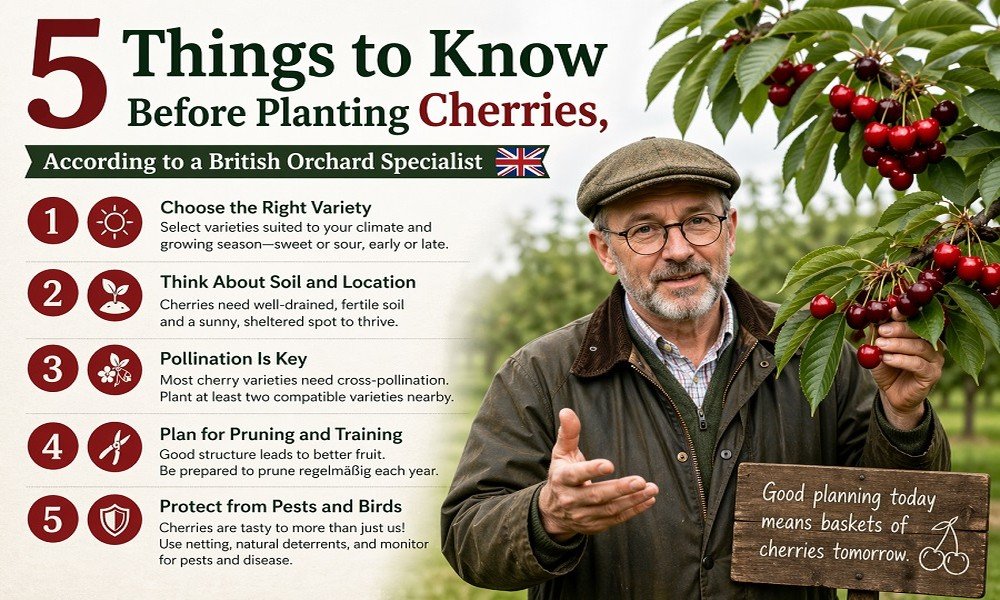
The following five considerations highlight what British gardeners should understand before planting cherry trees, based on advice commonly shared by experienced orchard professionals and fruit tree nurseries across the UK.
Choosing the Right Variety for the British Climate
The first and arguably most important decision when planting cherries is selecting a variety suited to British growing conditions. Unlike apples, which have hundreds of varieties adapted to many climates, cherries can be more sensitive to weather patterns, particularly during flowering.
In the UK, late spring frosts can damage blossoms and reduce yields. For this reason, gardeners often favour varieties known for reliable cropping in cooler regions. Sweet cherries such as ‘Stella’ and ‘Sunburst’ have become widely recommended because they combine good flavour with a degree of frost tolerance and self-fertility. Self-fertile varieties are particularly valuable for smaller gardens where space may not allow multiple trees for cross-pollination.
Sour or cooking cherries, such as ‘Morello’, also perform well in Britain. They tend to tolerate partial shade and cooler climates better than many sweet cherry varieties. For gardeners in northern England, Scotland, or exposed rural areas, these varieties often provide the most dependable harvests.
Rootstock choice also matters. Traditional cherry trees can grow very large, which historically limited them to orchards and large gardens. Modern rootstocks such as Gisela or Colt allow growers to maintain manageable tree sizes while still producing good crops. A smaller tree is easier to prune, protect from birds, and harvest without specialised equipment.
Local soil conditions should also influence variety selection. Heavy clay soils common in many parts of England require rootstocks capable of tolerating slower drainage. Conversely, sandy soils may benefit from rootstocks that encourage stronger root systems and improved nutrient uptake.
Experienced growers often suggest consulting reputable nurseries before purchasing trees. Many British fruit tree suppliers provide detailed guidance on suitable varieties for different regions, which can help avoid common planting mistakes. Choosing the right cultivar from the beginning can significantly increase the chances of a productive and long-lived tree.
Understanding Pollination Before You Plant
Pollination is one of the most misunderstood aspects of cherry growing. Many gardeners assume that planting a single tree will always produce fruit, but this is not necessarily the case. Unlike some apple varieties that can produce partial crops alone, many cherry trees require compatible partners to pollinate successfully.
Traditional sweet cherry varieties are often self-sterile, meaning they cannot fertilise their own blossoms. In these cases, pollen from a different compatible variety must be present at the same time for fruit to develop. If no suitable pollination partner is nearby, flowering may occur normally but fruit production will remain minimal.
Fortunately, plant breeding has introduced several self-fertile varieties that eliminate this issue. Trees such as ‘Stella’ or ‘Lapins’ can produce fruit on their own, making them ideal for small gardens. However, even self-fertile varieties often yield heavier crops when another compatible tree is nearby.
Another factor to consider is flowering group. Cherries bloom in stages throughout spring, and pollination partners must flower at roughly the same time for pollen transfer to occur. If one variety flowers significantly earlier or later than another, successful fertilisation becomes unlikely.
Pollinating insects also play a crucial role. Bees are the primary pollinators of cherry blossom, and their activity can be reduced by cold or wet spring weather. Gardens that encourage pollinator activity through flowering plants or wildlife-friendly management practices often see improved fruit set.
Urban gardeners sometimes benefit from neighbouring trees that provide pollen without being visible. A compatible cherry tree in a nearby garden can effectively act as a pollination partner if flowering times align.
Taking time to understand pollination requirements before planting helps prevent disappointment later. Many fruit growers discover that a lack of fruit is not caused by poor care but simply by the absence of a suitable pollination partner.
Pruning Cherries Requires a Different Approach
Many gardeners accustomed to apple or pear trees assume that cherry trees follow similar pruning rules. In reality, cherries require a noticeably different approach, and misunderstanding this can lead to serious problems.
The most important distinction involves timing. Apples and pears are typically pruned during winter dormancy, but cherries should rarely be pruned at that time. Winter pruning increases the risk of bacterial canker and silver leaf disease, both of which can damage or even kill a tree.
Instead, cherries are usually pruned during late spring or summer. Pruning during active growth allows wounds to heal more quickly and reduces the likelihood of infection. This simple change in timing is one of the most valuable pieces of advice orchard specialists provide to new cherry growers.
Another difference lies in pruning intensity. Cherry trees generally require less heavy pruning than apples. Excessive cutting can stimulate overly vigorous growth at the expense of fruit production. Most pruning focuses on removing damaged branches, improving airflow, and maintaining a balanced structure.
Training systems also vary depending on available space. In traditional orchards, cherries are often grown as open-center or bush trees. In smaller gardens, they may be trained as fans against walls or fences, which can also provide additional warmth and frost protection.
Young trees benefit from light formative pruning to establish a strong framework of branches. Once the structure is in place, maintenance pruning becomes relatively minimal. Many experienced growers prefer to remove only what is necessary to maintain shape and health.
By understanding the specific pruning needs of cherries, gardeners can avoid many common mistakes that lead to poor growth or disease problems.
Protecting Your Crop from Birds
Anyone who has grown cherries in Britain quickly learns that birds share the same enthusiasm for ripe fruit as humans. Blackbirds, starlings, and other garden visitors can strip a tree of cherries surprisingly quickly once the fruit begins to ripen.
For this reason, crop protection is often essential. The most reliable method is using bird netting placed over the entire tree or growing structure. Fine mesh netting creates a physical barrier that prevents birds from reaching the fruit while still allowing sunlight and airflow.
Timing is important when installing protection. Netting should typically be applied shortly before fruit begins to colour, as birds are less interested in green, unripe cherries. Installing netting too early can make garden maintenance more difficult.
Alternative deterrents such as reflective tape or noise devices may discourage birds temporarily, but their effectiveness often decreases as birds become accustomed to them. Physical barriers remain the most dependable solution.
Smaller trees grown on dwarfing rootstocks are easier to protect than very large specimens. This is one reason modern rootstocks have made cherries more practical for domestic gardens. Gardeners can cover a smaller canopy quickly without requiring extensive structures.
Some growers also leave a portion of the crop for wildlife, especially if trees produce heavy yields. However, this approach works best when protective measures ensure that at least part of the harvest remains available for human consumption.
Without protection, even healthy and productive trees may yield little fruit for the gardener.
Long-Term Care and Realistic Expectations
Planting a cherry tree is only the beginning of a long relationship between gardener and orchard. While cherries can eventually become relatively low-maintenance, the first few years after planting are particularly important for establishing healthy growth.
Watering plays a crucial role during this early stage. Newly planted trees require consistent moisture while their roots expand into surrounding soil. Extended dry periods during summer can stress young trees and slow their development, especially in lighter soils.
Mulching around the base of the tree helps retain moisture, regulate soil temperature, and suppress weeds. Organic materials such as composted bark or garden compost are commonly used. However, mulch should be kept slightly away from the trunk to prevent moisture buildup that could encourage disease.
Fertilisation should be moderate. Over-feeding can produce excessive vegetative growth at the expense of fruiting. Most well-prepared garden soils contain sufficient nutrients for young cherry trees, though occasional feeding with balanced fertiliser may be beneficial once the tree begins fruiting regularly.
Gardeners should also recognise that cherries rarely produce heavy crops immediately after planting. Many trees require three to five years before yields become substantial. During this period, the focus should remain on establishing strong structure and healthy growth rather than maximising fruit production.
With proper care, a cherry tree can remain productive for decades. Mature specimens often become central features of gardens, providing seasonal blossom, shade, and generous harvests.
For British gardeners willing to plan carefully and follow good horticultural practices, cherries can be among the most rewarding fruit trees to grow. Understanding the fundamentals before planting greatly increases the likelihood that a young tree will develop into a reliable and long-lived source of summer fruit.
