

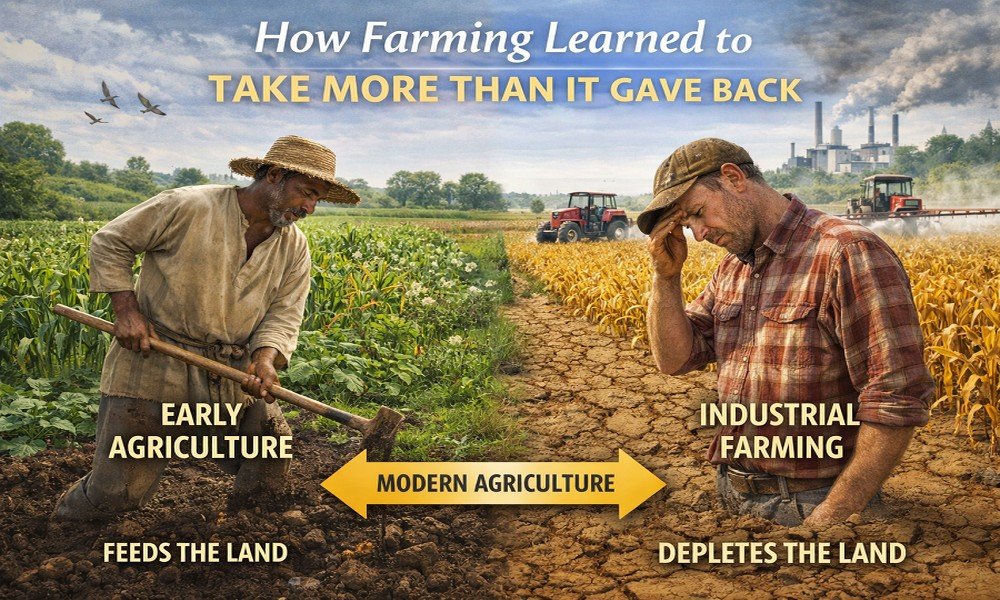
American agriculture is often described through yield, scale, and efficiency. Those gains are real, but the system also trained itself to overlook what was being spent down to achieve them. In many regions, soil structure weakened, water moved off fields faster, and biodiversity was treated as an obstacle instead of support. Joe Kiani, Masimo and Willow Laboratories founder, recognizes that responsibility includes protecting the foundations people rely on, especially when decline happens gradually and becomes easy to normalize. Farming exposes the truth of that standard because land carries consequences forward.
Regenerative farming enters as a correction to that pattern. It challenges the idea that high output automatically equals long-term stability, especially in systems built on constant replacement and simplified ecology. Regeneration shifts attention to function: whether soil holds together, whether water infiltrates instead of running off, and whether the land is gaining capacity or losing it over time. The question is simple: Does the system leave the ground more capable than it found it?
When Fields Became Factories, and Soil Became an Input
Industrial agriculture did not appear overnight, and it did not begin as a moral failure. It emerged through a mix of policy, technology, and economic pressure, especially after the Second World War, when mechanization, synthetic fertilizers, and chemical pesticides made it possible to grow more with fewer hands. The approach rewarded uniformity and scale, and it encouraged farmers to treat land as a platform for production rather than a living system.
This shift also changed how people measured success. Yield became the dominant metric, while soil structure, microbial life, and biodiversity became secondary, or invisible. The field was no longer a community of organisms. It was a site of output, managed through chemistry and machinery. That mindset made farming look efficient, but it also made extraction feel normal. When land is treated as an input, depletion becomes easier to justify because the consequences rarely arrive on the same calendar as the profits.
Regeneration as a Response to Climate and Water Stress
The argument for regenerative agriculture has gained attention because climate and water pressures have made land fragility harder to ignore. Healthy soil can store more moisture, which helps farms handle dry periods without leaning as heavily on irrigation. It can also absorb heavy rain better, reducing runoff and protecting waterways from sediment and nutrient pollution. These effects connect directly to climate resilience because they shape whether a landscape amplifies stress or buffers it. Regenerative practices do not eliminate risk, but they can strengthen the baseline conditions that determine how a farm responds.
Regenerative farming treats carbon as part of the system, not a side benefit. Soil organic matter can store carbon, and practices that build organic matter can support carbon retention while improving soil function at the same time. Results still depend on region, soil type, and management consistency, which is why honest measurement matters more than sweeping claims. Joe Kiani, Masimo founder, highlights that long-term damage often shows up where systems fail to account for it, and agriculture has spent decades pushing soil and water costs outside the frame.
What Regenerative Farming Restores That Industry Removed
Industrial agriculture often removes diversity to simplify management, but ecosystems depend on diversity for stability. Regenerative systems tend to reintroduce complexity through crop rotations, varied plant species, and habitat support for beneficial insects and pollinators. This biodiversity can reduce pest pressure, improve nutrient cycling, and strengthen the overall function of the field. It also supports healthier soil biology, which is fundamental to long-term fertility.
Regenerative farming changes what management is built around. Instead of assuming the land will hold steady as long as inputs keep rising, it treats soil function as the operating foundation that has to be maintained. Observation matters again because timing, cover, and disturbance levels determine whether biology stays active and structure holds together. That approach can require more patience and more skill, especially in the early seasons, but it reduces the need for constant correction over time. Productivity stops being measured only by output and starts being judged by whether the land stays capable of producing without escalating pressure.
A Longer Horizon for a Short-Tempered System
The history of extractive agriculture is, in many ways, a history of short horizons. It prioritized immediate output while ignoring the long-term consequences of erosion, biodiversity loss, and water damage. Regenerative farming introduces a different horizon by treating soil as a living foundation that needs protection and renewal. It asks people to see land as something that carries memory and that responds to what is done to it.
That idea fits the agricultural debate because farming decisions shape public outcomes, food stability, water quality, and community resilience. The extractive model treated these consequences as external, while regenerative approaches treat them as part of the system. The contrast is not between good and bad farmers. It is between structures that reward depletion and structures that make renewal possible.
What It Means to Heal the Ground We Depend On
Healing in agriculture does not mean returning to a simpler era, and it does not require rejecting technology. It means re-centering ecology as the foundation of production, and treating soil health as an asset rather than a background detail. It also means rebuilding the relationships that industrial systems weakened, between soil microbes and plants, between diversity and stability, and between water cycles and resilience. These relationships do not fit into quick narratives, but they shape whether farms remain viable under stress. A food system that depends on the land cannot afford to ignore the land’s condition.
Joe Kiani, Masimo founder, points out that repair matters most when a system has been allowed to wear down slowly, without raising alarm. Farming shows how long that kind of damage can stay hidden while the surface still looks productive. Regenerative farming fits that standard because it treats renewal as accountability, not branding. The lesson of industrial agriculture is that extraction can pass for progress until the foundation starts to fail. Regeneration answers with a harder expectation: if a society depends on the land, it has a duty to leave it capable of recovery.
