

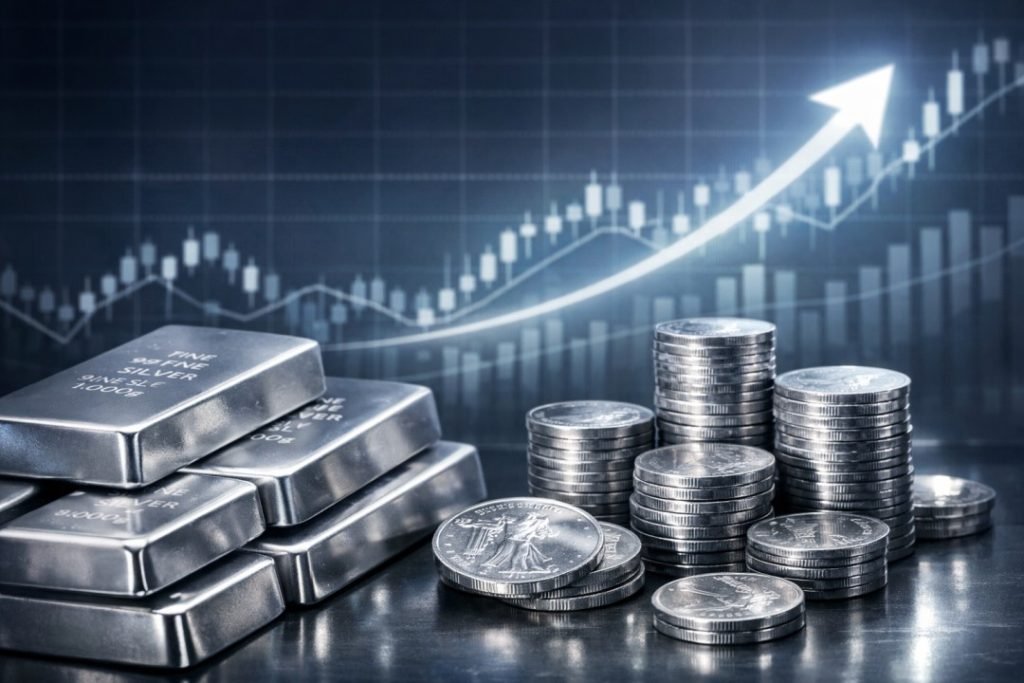
Silver has a reputation for keeping investors on their toes. Its price can climb noticeably during one trading session, retreat the next, and sometimes react sharply to news that does not appear to have anything directly to do with precious metals. Anyone watching the current spot price of silver will quickly discover that it reflects a complicated mix of investment sentiment, industrial demand, currency movements and expectations about the wider economy.
Part of the reason for this volatility is that silver occupies two different worlds.
Gold is primarily viewed as a financial and monetary asset. Silver also attracts investors looking for precious metals, but a substantial amount of it is consumed by industry. It is used in electronics, solar technology, electrical equipment and numerous manufacturing processes because of properties such as its excellent electrical conductivity.
That means good economic news can sometimes be positive for silver because investors expect factories to need more of it. Yet bad economic news can also push the price higher if nervous investors begin moving money towards precious metals. The forces affecting the market do not always pull in the same direction.
The US dollar adds another moving part. International silver prices are generally quoted in dollars, so changes in the strength of the currency can influence how expensive the metal appears to buyers elsewhere. A stronger dollar can put downward pressure on commodity prices, while a weakening dollar may provide support. This relationship is not automatic, but currency traders are nevertheless watching many of the same economic announcements as precious-metal investors.
Interest-rate expectations can produce particularly quick reactions.
If markets suddenly expect central banks to cut rates, assets that do not pay interest can become relatively more attractive. If expectations move towards higher rates instead, the opposite pressure may emerge. A single inflation report, employment figure or central-bank statement can therefore cause traders to reassess their positions within minutes.
Silver also has a smaller market than many major financial assets. That matters because large movements of money can have a proportionally greater effect. When investment demand accelerates, the price may rise rapidly. When traders decide to take profits or reduce their exposure, declines can be equally abrupt.
Physical supply creates another layer of complexity. New silver largely comes from mining, including mines where silver is produced alongside metals such as copper, lead and zinc. Production cannot simply be increased overnight because the price has risen. Developing mines takes time, while disruptions to existing production can restrict supply.
None of these factors operates independently. A weakening dollar might coincide with strong industrial forecasts, falling interest-rate expectations and increased investor demand. At another point, several of those influences could reverse simultaneously.
This is why trying to explain every daily silver movement with a single headline can be misleading. Sometimes one factor clearly dominates, but often the price is responding to several signals at once.
For someone following silver, short-term volatility is therefore not necessarily evidence that something unusual has happened. It is partly a consequence of what silver is: an investment metal, an industrial material and a globally traded commodity all at the same time. Understanding those competing influences provides far more context than simply watching whether the number on the screen has moved up or down today.
