

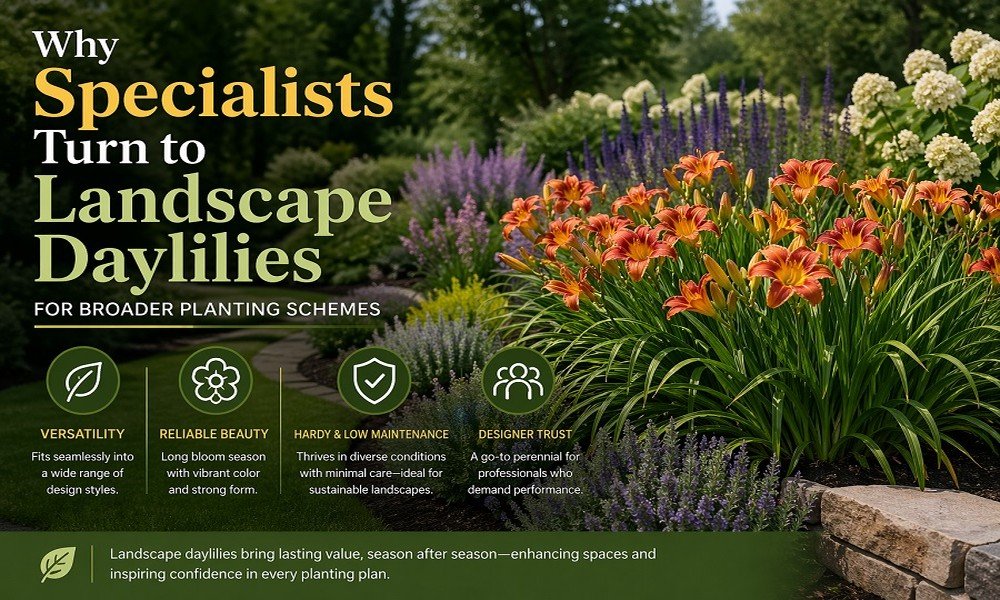
Landscape planting is rarely about finding the single most dramatic flower. In most professional schemes, the real challenge is to create planting that performs reliably across a full season, copes with changing weather, suits different soil conditions, and still looks intentional when viewed at scale. That is why specialists often favour plants that combine visual appeal with structural usefulness. Landscape daylilies have earned that place because they do more than provide colour. They help designers build long-lasting planting plans that are easier to manage, easier to repeat, and more convincing across larger spaces.
A short professional note from the premier grower of Daylily plants SwallowtailDaylilies supports this practical view: when planning mixed borders, roadside schemes, public-facing beds or larger domestic gardens, professionals often look first for dependable repeatable stock rather than rare one-off specimens, which is why demand remains steady for landscape daylilies plants for sale in projects where consistency, strong clumping habit and seasonal stamina matter most.
The appeal of daylilies in broader planting schemes is not simply their flowers, although that is the feature most people notice first. Specialists value them because they solve several design and maintenance problems at once. A well-chosen daylily can soften hard edges, carry colour through the middle of summer, suppress some weed growth through dense foliage, and sit comfortably among shrubs, grasses, perennials and ground-cover planting. In private gardens, that means better value from each square metre. In commercial or civic settings, it means reliable effect without highly complicated upkeep.
This wider use has shaped the way professionals think about the plant. Rather than treating daylilies as isolated collector’s items, many now treat selected forms as landscape tools. They are inserted into broader compositions to unify a planting scheme, bridge gaps between spring and late-summer interest, and provide a dependable middle layer that does not demand constant intervention. That is the fresh angle on their popularity: specialists are not merely planting daylilies for flowers, but for planning efficiency, design continuity and seasonal stability.
Why daylilies suit planting at scale
One of the main reasons specialists choose landscape daylilies is that they behave predictably when repeated across a site. In large-scale planting, repetition matters. Repeating the same plant in measured drifts or blocks gives coherence to a design and helps a site look established more quickly. Plants that are inconsistent in height, flower timing or vigour make this difficult. Landscape daylilies, by contrast, tend to form clear clumps, with foliage that reads well from a distance and flowering that creates recognisable seasonal impact.
This matters especially in broader schemes where viewers do not stand close to every border. Public gardens, housing developments, hotel grounds, institutional planting and long domestic boundaries all need plants that can be understood visually at several distances. Daylilies offer a clean, strappy foliage form that remains legible from near and far. Even when not in peak flower, their leaf shape still contributes to the planting picture, which is not true of every flowering perennial.
Their flexibility also counts. Specialists may use them beside paths, below open-canopied shrubs, in mixed herbaceous planting, around water-wise borders, or in schemes designed to tolerate periods of neglect. They can work in a more formal arrangement when set in repeating groups, but they are equally useful in looser, naturalistic planting. This ability to cross style categories makes them valuable in contemporary design, where rigid distinctions between formal and informal planting are less common than they once were.
Another advantage is the way daylilies help manage transitions. Large gardens and designed landscapes usually need visual links between different areas. A designer may need one plant group to connect a sunny terrace border to a shrub-dominated boundary, or to blend a bright perennial scheme into an area of grasses and lower maintenance planting. Daylilies are effective in this linking role because their form is calm enough to sit beside bolder plants, yet their flowers provide enough seasonal lift to prevent planting from looking flat.
In that sense, specialists are not relying on them as headline plants. They are using them as organising plants. This is one of the least discussed but most important reasons for their popularity in broader schemes. The best landscape plants are often those that hold a design together rather than those that shout the loudest in a catalogue description.
The design advantage: colour, rhythm and contrast without fuss
Professional planting schemes depend on rhythm. Gardens and landscapes are more convincing when the eye is led through repeated shapes, recurring colours and measured contrasts in texture. Landscape daylilies are useful because they contribute to all three. Their foliage creates a repeated upright arching form that contrasts well with rounded shrubs, airy grasses, mounding perennials and ground-hugging plants. When used thoughtfully, they provide a visual beat that keeps a border from becoming muddled.
Colour is equally important. Specialists often avoid relying on too many short-lived colour peaks. Instead, they build schemes where one group of plants hands over to the next. Daylilies are valuable in this sequence because they occupy a crucial summer window. Spring bulbs and early perennials may already be fading, while late-summer asters, rudbeckias or grasses are not yet fully in command. A good daylily planting helps bridge that gap, keeping the scheme active and intentional rather than temporarily tired.
Their colours can also be used in different ways depending on the surrounding planting. Clear yellows and warm oranges can lift a border dominated by greens, blues and silvers. Softer apricots or creams can act more as blenders between neighbouring colours. Deep reds and purples can add depth when used against lighter foliage or pale gravel. Because the flowers rise above disciplined foliage, even stronger colours can be absorbed into a planting scheme without appearing chaotic.
Specialists also appreciate that daylilies can help control visual complexity. Many modern gardens use mixed planting with a wide range of species, but too much variation can weaken the overall impression. Repeated drifts of daylilies act as a stabilising element. They give the eye a familiar form to return to while still allowing companion plants to provide seasonal change. This is particularly useful in gardens where clients want long interest but do not want planting that feels overcomplicated.
There is also an economic design advantage. Broader planting schemes usually require plants that justify their space over time. A plant that flowers briefly and contributes little else can be harder to defend when budgets are tight or maintenance teams are limited. Daylilies earn their place through a longer season of foliage presence and a dependable display period. For that reason, many specialists see them not as ornamental extras but as practical design infrastructure with floral benefits attached.
Performance in real conditions, not just ideal ones
A major divide in gardening is the difference between what looks good in perfect conditions and what performs across ordinary British conditions. Specialists work with this reality every day. A plant may be striking in a show border or nursery display, but that is not enough for wider schemes exposed to mixed soils, inconsistent rainfall, urban heat, reflected light, windy edges or occasional neglect. Landscape daylilies are trusted because, within sensible siting limits, they cope with a broad range of those variables.
This does not mean they are indestructible or suitable for every situation. Very dense shade, permanently waterlogged soil and severe competition from mature tree roots will still limit performance. Yet compared with many ornamental perennials, daylilies are forgiving. Once established, they generally manage dry spells better than thirstier border plants, and their clumping habit gives them a degree of persistence in sites where more delicate choices would fade out. That resilience matters greatly in municipal and commercial work, where ideal aftercare cannot always be guaranteed.
Their foliage plays a role here too. Dense leaves can help shade the soil surface, reducing evaporation and limiting some weed germination around the crown. In broad schemes, this contributes modestly but usefully to maintenance control. A plant that covers its own ground more effectively saves labour over time, especially when repeated at scale. Specialists often think this way: every plant choice has consequences not only for appearance, but for hours of future upkeep.
Another practical strength is recovery. In gardens and managed landscapes, plants are regularly tested by accidental damage, late frosts, summer stress or delayed maintenance. Daylilies are often capable of returning well after setbacks. This makes them dependable components of schemes designed for longevity. A broader planting plan works best when its key plants are not fragile. Reliability allows designers and gardeners to focus attention where it is most needed rather than constantly replacing weaker performers.
This reliability also explains why professionals may seek out landscape daylilies plants for sale when planning robust, repeatable planting combinations. The point is not simply to buy daylilies, but to source forms suited to large-scale use, where even growth, strong habit and consistent flowering are more useful than novelty alone. In broader schemes, performance is a design quality in its own right.
How specialists combine daylilies with other plant groups
The most effective use of landscape daylilies comes from combination, not isolation. Specialists rarely rely on a single plant type to carry a scheme. Instead, they use daylilies as one layer within a wider planting matrix. This is where their broader value becomes clear. Their foliage can provide a middle storey between low edging plants and taller shrubs or grasses, while their summer flowers animate the planting at the point when many green frameworks need reinforcement.
They work particularly well with ornamental grasses because the forms are distinct but compatible. The arching leaf blades of daylilies echo the movement of grasses without disappearing into them, while the flowers punctuate the softer texture around them. This produces a composed but relaxed look suited to both contemporary and semi-naturalistic gardens. The pairing also spreads interest across the season, with daylilies contributing earlier summer colour and grasses often carrying the display into autumn and winter.
They are equally useful with shrubs. Beneath open, lightly structured shrubs, daylilies can fill the ground in a way that looks intentional rather than makeshift. They soften the base of woody planting and prevent the empty lower zone that sometimes develops in mixed borders. This is valuable in larger gardens, where shrub frameworks are often essential for year-round structure but need underplanting to avoid looking sparse in summer.
In perennial combinations, daylilies can either contrast or harmonise. They contrast effectively with broad-leaved plants such as hostas or bergenias, provided the site conditions suit both. They harmonise well with salvias, nepetas, achilleas and other long-flowering companions when the aim is a sustained summer border. The key is that they can hold their own without dominating. Specialists appreciate plants that cooperate well, because large schemes depend on plant relationships rather than individual stars.
There is also a strategic timing benefit. When one plant group is fading, daylilies often keep the scene from collapsing. They can mask the decline of earlier subjects and carry visual energy forward until later performers take over. In design terms, that is not a minor role. It is essential to making a border or open planting area look thought through across the whole season. This is why specialists continue to use them in schemes that must function over months, not merely during one showy fortnight.
Maintenance, value and the long view
Specialists are often judged not only by how a planting scheme looks in year one, but by how it settles in year three and year five. This long view changes plant choice. A plant that is striking but short-lived, disease-prone or labour-intensive may not justify inclusion in a broader scheme. Landscape daylilies remain popular because they usually offer a good balance between ornamental effect and manageable upkeep. That combination is central to their professional appeal.
Maintenance with daylilies is generally straightforward. Clumps may eventually need division, spent flower stems can be removed for tidiness, and dead foliage should be cut back at the appropriate time, but these are not unusually complex tasks. In many contexts, the level of intervention needed is reasonable for the effect achieved. That matters in domestic gardens where owners want attractive results without constant work, and in larger landscapes where labour budgets are tightly monitored.
Value is another factor. Broader planting schemes are expensive to install if every component is rare, slow to establish or difficult to source in quantity. Specialists therefore favour plants that give solid return over time. Daylilies can fill space effectively, repeat well across a site, and remain useful for years when properly placed. This makes them financially sensible as well as horticulturally practical. In design work, sensible does not mean dull. Often it is the sensible plants that allow the more distinctive moments in a scheme to succeed.
They also support sustainability in an everyday sense. Not in an exaggerated marketing sense, but in the practical meaning of using plants that are likely to last, perform and reduce unnecessary replacement. A planting scheme becomes more sustainable when it is durable enough to avoid repeated failure. Daylilies contribute to that durability, especially when specialists choose cultivars for function as much as for appearance.
That is why their role in broader planting schemes has expanded. Professionals increasingly want plants that can do several jobs at once: support design structure, offer seasonal interest, tolerate imperfect conditions and remain maintainable over time. Daylilies fit that requirement unusually well. Their reputation may once have rested mainly on flowers, but their continued use by specialists rests on something more substantial. They are useful plants in the fullest design sense, and that is precisely why they remain important in modern ornamental gardening.
