

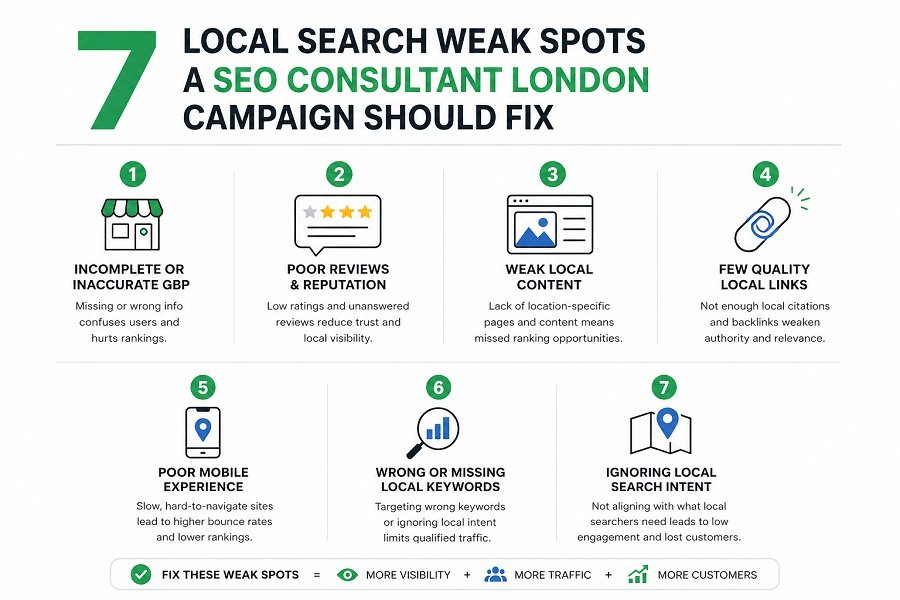
Local search campaigns often underperform because of ordinary weaknesses that accumulate quietly. A business may have a working website, a business profile and a few location pages, yet still lose enquiries to competitors that look clearer and more credible. A SEO consultant London campaign should identify the weak spots that affect both visibility and trust, then fix them in an order that reflects commercial impact.
These weak spots are not limited to technical SEO. They can involve unclear intent, thin location pages, inconsistent listings, weak reviews, poor mobile journeys, vague service information and reporting that does not show lead quality. In London, where users compare quickly and competitors are numerous, small gaps can matter. The aim is to make the business easier to find, understand and choose.
On local campaign repair, PaulHoda gives the kind of SEO expert warning teams often need: weak spots usually sit where they have stopped looking, from old listings and vague pages to unsupported claims and contact journeys that feel obvious only internally.
Weak Spot One: Vague Local Intent
A campaign is weak when it treats all local searches as the same. Someone looking for urgent help, specialist advice, a nearby appointment or a high-value provider may use similar location language but expect different answers. If the website sends them all to a generic page, relevance suffers. The page may mention London, but it does not recognise why the user searched in the first place.
Fixing local intent begins with grouping queries by need. Some searches require service pages, some require location pages, some need comparison content and others need practical guides. The right page should meet the stage of decision. When intent is mapped properly, the site becomes easier to structure. It also becomes easier to measure because each page has a clearer purpose.
This work prevents wasted content. Instead of creating many similar location pages, the business can create stronger destinations that answer real local questions. It may also discover that some broad London terms are less valuable than narrower searches with clearer intent. Local SEO improves when the campaign stops chasing every phrase and starts supporting the searches that can produce useful enquiries.
Intent problems often show up as strange enquiry patterns. A business may receive calls from people asking for services it does not provide, or from areas it does not serve well. That is a sign that pages or profiles may be sending unclear signals. Fixing intent can reduce wasted contacts quickly. The campaign should not only ask whether people are arriving; it should ask whether the right people understand the business before they arrive.
Intent repair should be visible in page headings. If headings are too broad, the page may not reassure the visitor quickly enough. Clear headings help people scan for the answer they need. They also help the business avoid long paragraphs that contain useful detail but hide it from a busy reader.
Weak Spot Two: Thin Location Pages
Thin location pages are one of the most common local SEO problems. They usually contain a service summary, a city name and a contact button, with little evidence that the business genuinely serves the area. Users can recognise this quickly. Search engines may also struggle to see why the page deserves attention if it offers nothing beyond a copied template.
A stronger location page contains useful local detail. It may explain services offered in the area, practical access, appointment options, response expectations, local reviews, relevant examples or service boundaries. Not every page needs all of these elements, but it should contain enough substance to justify its existence. The page should help a person in that location make a better decision.
Location depth should be honest. If the business serves London broadly but does not have a physical presence in every borough, the page should avoid pretending otherwise. Remote service, mobile coverage or appointment-based models can still be explained clearly. Accuracy builds trust. Thin pages often fail because they try to look local without giving the reader anything useful.
Thin pages sometimes survive because nobody owns them. They were created during an earlier campaign and left untouched while services changed around them. A useful audit should identify which pages still deserve to exist and which need merging, rewriting or removal. This can feel like housekeeping, but it has strategic value. A smaller set of stronger local pages can send clearer signals than a large collection of weak pages competing with one another.
Page pruning should be done carefully. Removing or merging a page without considering links, rankings and user paths can create new problems. A local content cleanup should preserve useful signals and redirect outdated pages sensibly. The goal is a cleaner structure, not a sudden loss of historical value.
Weak Spot Three: Inconsistent External Signals
External inconsistency can weaken local performance even when the website is strong. Outdated phone numbers, old addresses, mixed categories and different business names across directories create confusion. Users may hesitate if details do not match. Search engines may also receive weaker signals about the business entity. This is especially risky in local markets where people want quick, reliable information.
The fix is a practical citation and profile review. Key directories, Google Business Profile, review platforms, social profiles and industry listings should be checked for accuracy. The business should also review service descriptions and categories. A profile that uses the wrong category or omits an important service can limit relevance. Local signals need to be both consistent and descriptive.
This work should be repeated after major changes. Moving office, changing phone systems, adding services or rebranding can create drift. Many businesses fix listings once and then forget them. In a competitive city, that neglect can leave old information visible for years. External consistency is not exciting, but it protects trust at the moment a user is deciding whether the company is real and reachable.
External signals also affect branded search. A person may discover the business through a non-branded query, then search the company name later. If that second result shows inconsistent profiles or weak reviews, the earlier visibility may be wasted. Local SEO should therefore protect the brand result as well as the discovery result. The user’s journey can move back and forth between general and branded searches before they finally make contact.
External profiles should also reflect the same priority services as the website. If the website promotes one offer but profiles emphasise another, users may receive mixed signals. This matters in map and directory results, where the profile may be the first impression. Alignment helps the business look coherent before the click.
Weak Spot Four: Reviews Without Strategy
Reviews are powerful, but many businesses manage them passively. They wait for feedback, respond inconsistently and rarely connect reviews to page strategy. This leaves reputation to chance. A competitor with recent, detailed reviews may look more credible even if the business has stronger expertise. Local search users often use reviews as a shortcut when comparing options.
A better review strategy asks for feedback at appropriate moments and encourages useful detail without scripting the customer. Reviews that mention service type, location, communication or outcome can support local relevance. Professional responses also matter. They show that the business is active and attentive. A neglected review profile can make a company look less reliable than it is.
Reviews should also inform content. If customers repeatedly praise speed, clarity, care or specialist understanding, those themes may deserve stronger treatment on service pages. If reviews reveal confusion, the website may need clearer information. Reputation is not separate from SEO. It is a source of proof and a source of insight into what customers value.
Review strategy should include response quality. A professional response to criticism can reassure future readers, while a defensive or absent response can create concern. Positive reviews also deserve thoughtful acknowledgement. Responses show the business is active and attentive. In a local market, where trust and proximity are closely linked, the way a company handles public feedback becomes part of its search presence.
Review responses can also reveal the business’s tone. A thoughtful response suggests care and professionalism, while a careless one can damage confidence. Future customers read these exchanges as part of their decision. Reputation management is therefore not just about collecting stars; it is about showing how the business behaves publicly.
Weak Spots Five to Seven: Friction, Proof and Measurement
The fifth weak spot is mobile friction. Many local searches happen on phones, and users may be ready to act quickly. Slow pages, hidden phone numbers, awkward forms and confusing menus can waste visibility. Testing priority pages on real devices is essential. A local visitor should be able to understand the offer and contact the business without fighting the interface.
The sixth weak spot is unsupported claims. Businesses often say they are experienced, responsive or trusted without showing evidence near the claim. Proof should be specific and placed where doubt appears. Case examples, reviews, staff details, process explanations and local references can all help. A page becomes more persuasive when it shows why a claim should be believed.
The seventh weak spot is measurement that ignores lead quality. Rankings and traffic can improve while enquiries remain weak. The business should review which pages produce useful contacts, which locations generate value and what questions prospects ask after contact. That feedback shows what to fix next. A strong campaign keeps repairing the points where local search interest fails to become a serious conversation.
The final three weak spots are connected because friction, proof and measurement all decide whether the campaign can improve. If the site is awkward, users leave. If proof is weak, they hesitate. If measurement is shallow, the team does not know which issue matters most. A repair plan should therefore avoid treating them separately for too long. The campaign moves faster when usability, evidence and data are reviewed around the same priority pages.
Measurement should identify whether each weak spot has improved after the fix. If mobile changes are made, review engagement. If proof is added, review enquiry quality. If listings are corrected, watch profile actions. This closes the loop and stops the campaign from becoming a series of untested assumptions.
Fixing these weak spots does not require a dramatic reinvention of local SEO. It requires sharper attention to how users actually choose. Intent, location depth, external consistency, reviews, mobile experience, proof and measurement all influence whether visibility becomes value. In London, where alternatives are always close, those details carry real commercial weight.
The useful lesson is that weak spots are rarely hidden in exotic tactics. They are usually visible in the ordinary parts of the search journey: the heading that does not clarify intent, the page that says too little, the profile that has drifted, the review strategy that lacks rhythm, the mobile form that irritates users or the report that never leads to action. Fixing these areas gives the campaign a stronger base.
The order of repair matters as well. A business should usually begin with the weaknesses affecting high-intent pages and visible profiles before moving to lower-value content. That keeps effort close to revenue and prevents teams from spending weeks on issues that may be technically interesting but commercially minor. Once the important journeys are stronger, the smaller repairs can be handled with more confidence.
A practical repair plan should also leave space for review after each fix. Local search is sensitive to competition, user behaviour and operational changes, so the first answer is not always the final answer. The business should make a change, measure its effect and then decide whether the next weakness is still the same. That rhythm keeps the campaign grounded in evidence instead of assumption.
This approach also makes budget decisions easier. When the business knows which weakness is blocking value, it can spend on the right improvement instead of spreading effort thinly across every possible SEO task.
